Friday, May 01, 2020

People want revolution.


In order to safeguard the wealth they have robbed from us and insure more profits, it is in the interests of the capitalist class to have a divided working class A working class that is divided is one that is not capable of defending itself or fighting in its own interests. The capitalists have a vast array of tools of oppression to keep the working class divided. They continually promote discord among us to keep us weak, fighting among ourselves, fighting against our brothers and sisters throughout the world. We are an organisation that fights political delusions and ideological illusions. Only a united working class  can effective wage class war against the ruling capitalists. This unity must be based on the struggle in our own interests – political working unity – a unity in common struggle against capitalism. Only with unity can we struggle for the emancipation of working peoples and our class from a common enemy.

The World Socialist Movement is an organisation of men and women committed to building a socialist society. Only within a socialist society can we take control over our own lives and bring an end to war, economic insecurity and sexual and racial inequality. Only within socialism can all people fully develop their potential and capabilities. We must bring about the end of the present capitalist economic and political system that is imposed upon our lives. It is a system which is inherently based on misery and exploitation. It profits a wealthy few at the expense of the vast majority of working people throughout  the world. It generates war. It keeps people weak and powerless by fostering racial, national and gender divisions. 

This system is controlled by a small number of extremely rich ruling class who use major institutions, including the government, to protect their interests and wealth and to maintain their control over our lives. In a class society, the dominant economic class makes and enforces the rules to ensure the actual rule of those who own and control the means of production. They own and manipulate the media. They purchase the political parties office-holders whose role is to serve those whose campaign contributions put them in their lucrative positions

At the workplace, it is clear that democracy does not exist. Working people exist under a system of wage slavery. In order to survive workers have no choice but to sell their labour power at a price determined by the capitalists. 

As long as capitalists exist on the profits from the sale of this labour power by vast numbers of working people, working people will have no freedom. The appropriation, by a small minority to be used for personal gain and profit, of the wealth produced by labour power must be stopped and replaced by new relations to production where the workers own and control the means of production, and their labour is for the good of the vast majority. We must change the basis upon which the exploitation and enslavement of people exists by abolishing the capitalist system.

It should be clear that the trade unions are absolutely necessary to the workers under capitalism. The workers trade union is the only organisation which stands between them and the capitalists. The trade union defends the workers, winning higher wages, better working conditions, and a measure of job security and dignity. 

Wherever capitalism has developed, trade unions have emerged as the major institutions of economic defence of the working class. Trade unions teach workers that the bosses must be fought in order to make gains in the worker’s standard of living, and they do teach workers that the working class must be united, and that its interests are inevitably opposed to the bosses. But it should be noted that trade unions, even at their best, are of limited benefit. Trade unions do not teach workers that the whole government is a front for the employers. Presently, no trade union talks about the need for socialism, or explains that ultimately it will be necessary to overthrow the state which is controlled by the employing class. Without socialism, the working class is reduced to a constant struggle against the effects of capitalism because without socialism, the foundation of capitalist exploitation remains intact. It remains the job of the WSM to explain these things and convince our fellow-workers of the need to overthrow the whole capitalist system altogether. 

Socialism is not just an ideal but a workable alternative system where political and economic power is held and used to benefit not a handful of people, but all people. We shall always attempt to present our ideas in the clearest way possible. It will be working people who will make socialism a reality.

The exploitative system ofcapitalism in direct conflict with the interests of the vast majority of the people throughout the world. The wealth of this society was and is created by working people, yet our human labor is expropriated by  profiteers and elites to enrich themselves at the expense of those who make the products and deliver services. Working people are exploited when a portion of their human labor is stolen from them by the capitalists for the sake of profits. The relationship of the capitalist class to the working class is inevitably exploitative. This is the essence of class society. We have no common ground, no basis for friendship, no reconcilaition or peace with the ruling class as long as it exists. The working class in their fight for socialism will lay the foundations for their own liberation. The WSM fights for the complete social, economic and political equality for working peoples. We see the way to fight the capitalist ideology and culture is to educate ourselves as to the contradictions and oppressiveness of the capitalist system. In so doing, we strengthen the class movement against capitalist exploitation. An essential part of building a revolutionary working class movement to end capitalism and build socialism is the development and furtherance of a socialist party. Right now there are many groups claiming to be socialist but there is just one which is dedicated to overthrowing the capitalist system and not reforming it - the World Socialist Movement.  


May Day - Our goal always remains the same

We have said many times that socialism is the sole solution for the problems of the world. The Socialist Party did not invent humanity’s aspirations for a just, egalitarian and free society; mankind have cherished such a dream for a very long time. Socialism is a movement based upon the historic evolution of the past and the economic conditions of the present. It is not, therefore, something that has been hatched in the brain and the imagination of some idealist philosopher. Socialism builds upon reality. It looks upon society as an ever-changing category, and it is able to explain why society has changed in the past and why it must change in the future. The reason why socialism is able to explain the past and the present and to foreshadow the future is because it establishes itself upon the facts of history and the truths of economic science.

Sadly socialism has lost in actuality and immediacy by the fact of being postponed to a far-off future. We believe that the emancipation of humanity from the age-long thraldom of the class rule will be achieved in our own time. When we talk about the inevitability of socialism we assume that our fellow-workers will continue to struggle for their rights. Were they, on the other hand, to fatalistically remain tamely passive wait till socialism came to them, they would soon lose all the rights that they have now and become more. slaves. When workers grow so class conscious and so well organised as to make their exploitation impossible then capitalists would have reached the end of their reign. That is what we understand by social revolution. The spirit of the revolution is stirring once more. Society is changing more rapidly today than ever before in human history. Capitalism is rushing civilisation to its doom. Capitalist society is today clearly treading the road to the abyss. Socialism proposes the common ownership of all the means of production and distribution, the operation of industry in the interest of the whole people, the application of every machine to reducing working hours, the equality of all races and sexe, the abolition of poverty, the end of war, the economic freedom of every human being — and thus emancipated from the cruel and degrading thralldom of the capitalist system.

Thursday, April 30, 2020

No Population Explosion in Scotland

5.46 million people living in Scotland as of 30 June 2019, an increase of 25,200.
30,200 more people moved to Scotland than left the country in the year to mid-2019, arriving from both overseas and the rest of the UK.
There was no natural growth as deaths outstripped births over the same time. There were 5,600 more deaths than births.
Three-quarters of council areas experienced population grown, but eight areas saw declines. Most of the population growth was in Edinburgh and Glasgow and neighbouring areas. Population declines affected mainly rural areas, some islands and other areas in the west of Scotland.
Scotland's population is ageing. In mid-2019, 19% of the population were aged 65 and over, compared with 17% a decade earlier in mid-2009.


Work in Socialism

Work in socialism will be on the basis of voluntary co-operation and the democratic administration of society. The production and distribution of wealth will be controlled by the whole of society. 

Socialism will also involve the rational use of resources and areas, using those resources and areas for the activities to which they are best suited. In socialism there will be various sorts of worldwide administration systems which will assess people’s needs and organise production accordingly to maintain adequate supplies to all areas. The production and distribution of wealth will be controlled by the whole of society. The social organisation of socialism will be under the complete control of society’s members. There will probably be delegate assemblies. However the exact form which democracy in socialism will take, cannot be presently determined other than in general terms because , the very form must itself be the result of a great and serious democratic debate. Also we are in an information revolution where the development of new technology which could aid democracy keeps advancing. One thing is certain, however, socialism will be the most democratic form of society possible, and, as the means of living will be owned in common, no minority will be able to enforce its will upon the majority by threatening to withhold their livelihood. Because no one will be in a position to coerce others, all work in socialism will be voluntary. 

Work will not take place under coercive or exploitative conditions. Instead, each person will contribute to society as much of their talents and abilities as they are willing to give. Due to the fact that the producers will no longer be exploited (robbed of the full fruits of their labour) in the course of production; nor forced to work in conditions which are sometimes detrimental to their health; nor deprived of creativeness in work; nor forced to compete with one another for pay and promotion; nor forced to labour in circumstances which they don’t fully control; nor forced to divide their activity between employment and “leisure” (neither of which are fully satisfying)—work in socialism will be more pleasant with increased work satisfaction, a definite end and need in itself. 

Mankind will, for the first time, be in complete control of its circumstances, it will create and recreate its circumstances, it will venture to the very limits of its potentiality, it will continually extend itself to an extent that could never be achieved under the present social organisation. 

Mankind, in socialism, will be revealed as the supreme creative artist, we shall constantly beautify and redesign our world, we shall continuously acquire more knowledge, liberating itself from the restrictions. Socialism requires human action for its achievement. What is needed, is for all those desire a new society must unite with like-minded people to change society.

Capital and labour can be described as interdependent only in the sense that they are opposite sides of the class struggle of capitalism. This does not imply a unity of interest; the two classes have interests in opposition, over the division of wealth in capitalist society and finally over the transformation of society from capitalism to socialism.

Capitalism came into existence after a bitter, and often bloody, struggle in which one side was protecting its privileges and property rights while the other was seeking to assume the position of social domination. Perhaps both sides can be described as “greedy” but this judgment does not fill the bill historically; it ignores the reality of social change and revolution, which is a process of social adaptation to developments in the mode of production. “Motivation”, in terms of human desires, is secondary to that.

Class society is then part and parcel of social evolution; capitalism, which is the final form of class society, has as one of its essential features the drive to accumulate capital, to amass and invest wealth with the object of producing more wealth for sale at a profit. The privileges which go with being a member of the dominant class in society, and the accumulation of capital, are not examples of “greed”—they are unavoidable features of a necessary phase in the development towards a class-free society.

“Greed ' is in any case a factor relating to its conditions; it can exist only in times of shortage and restrictions and becomes more evident as scarcity develops. When wealth is freely available, as it will be in socialism, greed will not exist—it will be an attitude so archaic that it will be almost beyond understanding. This illustrates the fact that “ethics” are not eternal and unchanging; each social system has its own, in a sort of superstructure of ideas and responses which rest on its economic base. Capitalism’s ethics are those of division, of panic, of destruction and competition. Socialism’s will be those of co-operation, abundance and efficiency.

Capitalism has brought about a tremendous increase in the “material powers of production”, to the point where society is now technically capable of producing an abundance of goods and services. But this abundance is not produced under capitalism, because its highest priority, profit, acts as a fetter on the productive forces. The socialist revolution will usher in new relations of production — common ownership and production for use—which will enable this potential for abundance to be realized and will no longer hold back the development of the forces of production. Common ownership will be linked with democratic control of the means of production to resolve another of the contradictions of capitalism, that between social production and class monopoly of the means of production.

The establishment of socialism requires a revolution carried out by a working class who have come to understand the nature of capitalism and the desirability of socialism, and who are willing to run a socialist system and make it work. The material conditions for socialism already exist. The Socialist Party exists to spread the idea of socialism and to act as the political tool of the socialist working class who will carry out this revolution.

Wednesday, April 29, 2020

Ill-Gotten Gains

Gadhafi's close associate Ali Dabaiba, who was part of an elite circle known as "companions of the leader," reportedly squirreled away $7 billion while on a salary of only £12,000 and a 2018 investigation alleged he invested some of it in prestigious property across the UK. 

The Organised Crime and Corruption Reporting Project said that included Scotland's most significant stately home still in private hands, Taymouth Castle.


The World For All

For ourselves, socialism is impossible without democracy, both in how we organise and in what we organise for. We practice what we preach. Our job, as socialists, is to find a way to propose radical ideas and democratic practices, even though we may risk being marginalised or even ostracised. The Socialist Party is infused with democratic principles. What most concerns us is to lay the foundation of an for the policy of the cooperative commonwealth. Socialism aims at giving a meaning to people's life and work; enabling freedom and permitting the positive aspects of people’s personality to flourish; creating connections between the individual and those around us and reconciling humanity with nature. These are not aspirations for some hazy and distant future but our immediate demands for today. Socialism is not "nationalisation" nor "central planning" or even an "increase in the standard of living." It is to understand that the real crisis of capitalism is due to "the anarchy of the market." The task of the Socialist Party is transform our vision of society and our conception of the world. Socialism is working people's conscious direction of their own lives. Capitalism divides society. Socialist society implies people's self-organisation and entails the immediate abolition of the division of society into conflicting classes. Workers' self-management will be possible only if people's attitudes alter radically and running society becomes a meaningful part of our daily lives when people it. Analyse the case for socialism. Criticise if you so wish, by all means, but apply reason to the matter as well, for by so doing better understanding, greater knowledge, and a speedier establishment of the Socialist Commonwealth will result. One of the important facts of capitalist life is that it is a class divided system, in which two groups of people, between them making up the population of the developed world, face each other in conflict over the ownership of wealth. The parties of capitalism try to hide this fact, by talking about a unity of interests, about everyone working for the national good as if the interests of the coal miner are the same as those of the stock holder. As the interests of the two classes in society to day are in conflict, sooner or later the conflict must be determined. Therefore it would be wise for the working class, being the class seeking its emancipation, to be ready with its alternative. And what alternative have they but socialism?

Political parties are themselves fighting the class war, but on the other side of the line. They stand for the interests of the ruling class, for the propping up of a social system in which a minority own and control the means of living with all that follows from that in terms of poverty against privilege, freedom against repression. Any differences they may have are over the tactics to be used in that propping up and in fighting that class war. At times, a government may decide on the tactics of confrontation; at others they may use the policy of conciliation, of trying to persuade the workers on the other side of the struggle not to use any power they may have, to negotiate rather than use force in the sense of a strike or something similar. And when it comes to an election they are again united, in their respective appeal to the political naivety of the working class who are open to be convinced that minor differences on issues like trade are worth voting for or against. This should be a lesson to anyone who thinks it possible to make progress towards socialism with a policy of compromise with political ignorance or of winning support on day-to-day issues.

Mankind has developed vast technological possibilities. At present, however, there is gulf between what is potentially possible and what is actually realised. The contrast between the two and the question of how to reconcile them is the most pressing problem that confronts mankind today.


Concrete examples abound.

That people go hungry despite the fact that it is technologically possible to feed the world;
That schools, factories, homes, etc., are not built in sufficient numbers to satisfy the need for them—despite the necessary materials and manpower being available.  
That not enough of the many other items that are necessary for a pleasant human existence are produced—despite the existence of the requisite powers for their production and we have already witnessed under the current pandemic that hospitals can be providedand factories transformed to produce vital equipment and supplies in a matter of days;
That artistic and intellectual development, and scientific and medical research is limited—despite the vast human potential for such development;
That millions of people in the world are deprived of  the opportunity to usefully employ their talents—despite their desire contribute their talents and skills.

The answer to the problem of how to realise humanity’s full potential lies in the replacement of the present society with a new social system in which everyone owns the means of living in common— socialism where the wealth collectively produced will belong to everyone. Each person will have equal rights of access to the shared store-houses, each will determine her/his own needs and take freely from the common stock. This concept of wealth distribution is termed “free access”, and it means precisely that. For in socialism, the wealth of the planet will not be bought or sold on a market, it will not be exchanged for money, but rather it will be made freely available so that anyone who needs it can take it.

Because it will not be restricted by the market and the profit motive, production create the abundance that it is now technologically capable of. Production in socialism to satisfy society’s needs, not for profit. Because there will be no market, the work currently done by millions of people will become unnecessary. Socialism will have no need the services performed by those who work in finance, in banks, insurance companies or building societies. Nor will it need check-out cashiers or security personnel. Also, socialism will not require the police, prison guards, armed forces, legal and judicial systems, nor the vast media organisations whose main tasks are the ideological maintenance of the dominant position of the owning class. Instead of doing these socially useless jobs, the people presently undertaking them would, in socialism, together with those who are now unemployed, be able to be constructive and creative. Socialism will mean the liberation of mankind from such useless and uncreative work and the mobilisation of all human abilities for the extension of human abilities.

Tuesday, April 28, 2020

Testing to Destruction (1987)


Book Review from the April 1987 issue of the Socialist Standard

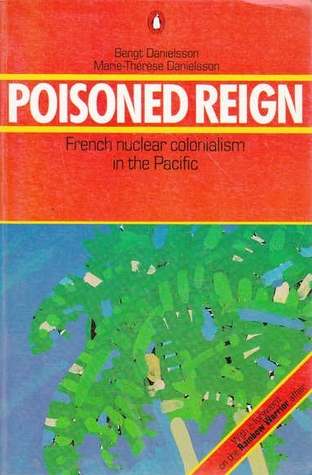
Poisoned Reign. French Nuclear Colonialism in the Pacific by Bengt Danielsson and Marie-Therese Danielsson (Penguin Books 1986)

On 10 July 1985 the Greenpeace ship Rainbow Warrior was blown up in Auckland harbour by two French agents. This act might appear to be surprising, considering the fact that both France and New Zealand are members of the "free world". This book tells the story of how successive French governments, including the "socialists" who changed from opposition to support, have been determined to use French Polynesia for nuclear weapons testing and not let any opposition get in the way.

The post-war years saw the great European empires in decline. When the French were being kicked out of Algeria, they were on the lookout for an alternative nuclear testing site to the Sahara. French Polynesia seemed the best bet — its islands are spread over an area the size of Europe and the 120,000 inhabitants were easy-going and the French had been manipulating them for years. The fact that the South Pacific is rich in food, metals and oil was another reason to maintain French dominance.

Other countries at this time were also testing nuclear weapons — the British at Christmas Island, the Americans in the Marshall Islands, the Russians in Siberia, and the Chinese in parts of Mongolia and Tibet. None of them showed much concern for the effects this would have on the local population.

When the French nuclear testing programme was announced in the early sixties the local people were mostly opposed to it. But this opposition was ineffective — the islands were run from France and the various institutions available to the islanders, to have a say in their affairs, were powerless. The authorities used various methods, devious and oppressive, to neutralise this opposition.

On 2 July 1966 the first French nuclear bomb was exploded above Moruroa Atoll. The French President, de Gaulle, was there to observe. He had made many flowery speeches claiming a great regard for. and affinity with, the Polynesian people, who were the first overseas territory to recognise the Free French during the war and who had sent a battalion to two world wars.

The French nuclear authorities, when dismissing the dangers of the tests, had said that the bombs would only be exploded when the wind was blowing east, away from the inhabited areas. This was despite the fact that winds in the South Pacific can blow in many different directions during the same day. However, when de Gaulle was there the wind kept blowing straight towards inhabited areas. Rather than keep the General waiting, the bomb was exploded anyway. The fall-out reached as far west as Fiji and Samoa. Islanders in the vicinity of Moruroa were given advice on how to protect themselves They were told not to drink rain water or eat fish for a while. This advice was not particularly helpful as this is precisely what the islanders exist on.

The nuclear programme had other effects on the islanders. Many of them were needed to work on the project. They were enticed to Tahiti by high wages only to end up in slums around Papeete, the largest town. They had to endure filthy conditions and crime, prostitution and drunkenness all increased sharply. As most of the work was needed at the start of the programme, when this finished they found themselves unemployed and unable to get back to their islands, as they had been promised.

By 1974, 42 French nuclear bombs had been exploded in the Pacific skies. Due to pressure from other Pacific countries and environmentalists the French government decided to continue its testing underground. They still used Moruroa. despite the fact that a Pacific atoll is one of the worst possible sites. The rock is thin and brittle and the many tests carried out almost certainly caused radioactive leakage and contamination of fish, plankton, shells, dams and squid regularly eaten by the local population.

The extent of the pollution caused by these tests and their resulting effect on the population can only be guessed at, as the authorities engage in the usual practice of secrecy and cover up. No reliable health figures are published and safety standards certainly appear lax. Much of the nuclear waste was dumped on the north of the atoll and washed away by several cyclones and tidal floods which have become more common in recent years. Some of these tidal waves will have been caused by explosions blowing out the side of the atoll, spilling out its radioactive muck. The fact that by 1985, 115 French nuclear devices had been detonated in the Pacific along with 106 American and 21 British, does not bode well for the future health of the islanders.

The authors tell the story of the French nuclear programme well, but their analysis of why it took place, with stories of politicians' duplicity and pride is weak. They clearly disapprove of French attempts to keep up with the superpowers and be independent and are sad that French public opinion doesn't seem to care. Unfortunately, the fact that any capitalist government exists to defend its national interest, and will develop whatever weapons it can to do this, with scant regard for the effects on people, escapes them.

There was a statement recently from a French government spokesman that they might stop nuclear testing at Moruroa as even they think that the atoll cannot take any more blasts. The underground rock is apparently in a very fragile, unstable condition. This will come as a relief to the people in the Pacific, although others had better watch out — the spokesman said they were searching the North Atlantic for an alternative.
Ian Ratcliffe
Dundee