Wednesday, November 10, 2021

Selfish Capitalism v Sane Socialism


Many people tend to associate green campaigners with tree-hugging liberals but sadly there are few on the fringes of the environment movement determined to use the climate change crisis by blaming over-population as its cause to promote xenophobia and anti-immigration. Nor is it a new development but one that can trace its roots to the ‘blood and soil’ nationalism of Nazism.


What does "overpopulation" mean? It is not a simple question of numbers. It would be absurd to suggest that the uninhabitable Arctic regions are under-populated as compared with, say, the U.S.A., obviously natural factors must be taken into account. It is equally obvious that the same natural resources in succeeding ages with improved means of wealth production can support larger populations. Again, it is true that, as the industry is organised today, it will be found generally that dense populations can more conveniently be maintained in industrial areas than in agricultural areas.


The workers are not poor because of over-population, or low-wage immigrants, or foreign competition from high or low-waged nations, or because America bars further immigration, or because of protection or free trade, or because they don't work hard enough, or because they work too hard, or because raw materials are monopolised by certain capitalist groups.


 The workers are poor because they are workers. They live in a capitalist world, where private property in the means of life means wealth, and being propertyless means the necessity of working and the accompaniment of economic subjection and poverty. The conditions of work and of the worker's standard of living are set by the capitalist system. Ending exploitation, utilising existing powers of production to the full, eliminating waste, are all dependent on the solution of the political problem of the conquest of political power.


Many environmentalists dismiss the contention that Nature is sufficiently bountiful for our needs. They ignore that more than half of the working population are not engaged in producing wealth at all, but are either idle or are carrying on purely wasteful services called into being by the capitalist system. There obviously are problems of population, but the problem of working-class poverty is not one of these. 


Does anybody really believe that if the world’s population was drastically reduced to a few billion, the forest would not be logged to depletion, the pollutants would not be spewed, and greenhouse gas wouldn’t still accumulate in the air? These would just advance at a slower pace, not disappear.


The World Socialist Movement (WSM) has always held that a society of abundance for all is possible and can be quickly become a reality. 


Technology has developed to the point where society can produce enough for everybody. What is lacking is the required movement to bring such a society into being.


Some scenarios assume that people love luxury and that they loathe work. 


We suggest that neither of these is fully correct and take their reasoning from projecting into socialism the capitalist ethos.  


Our critics remain fixated on what we can call the ‘Lazy, Greedy Hypothesis’ which simplistically preaches the conventional wisdom about peoples selfishness’ and rejects a system that abolishes money, prices and the whole exchange economy, asserting that a money-free scheme would permit the least socially responsible to ‘win’ out because they would take more and give less.


Are some innately selfish and inherently idle? We say no and don’t share in this pessimistic perspective.


We have always thought we left Original Sin to the religious blinkered, not for the progressive-minded to accept.


Human behaviour reflects society. In a dog-eat-dog society such as capitalism, people feel insecure.


Unappreciated and humiliated, there is a tendency for individuals to validate their sense of worth through the accumulation of possessions and conspicuous consumption to compensate for low status and low self-esteem.


Capitalism requires consumption, whether it improves our lives or not, and there is a huge industry devoted to persuading us to consume.


Businesses are compelled to produce more in order to maximise profits with the effect that it creates the enormous waste of consumerism. Obsolescence is built into products that are designed to be irreparable and disposable so that customers are trapped in a throwaway cycle of purchasing upgrades and replacements.


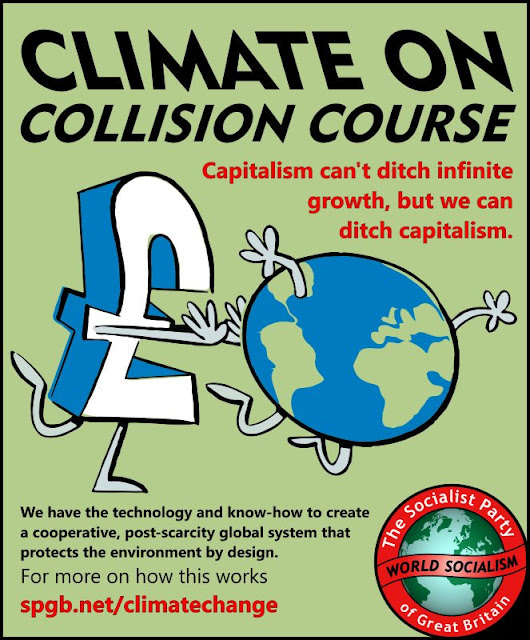
The destruction of ecosystems and the capitalist exchange economy are inseparable parts of the same problem. The capitalist system depends upon growth and accumulation to sustain itself.

Tuesday, November 09, 2021

Policing at the COP

 The occupants of a disused building in Glasgow that was reopened to offer emergency accommodation for climate activists have accused police of trying to break into the site with a battering ram and batons drawn early on Monday morning.

The activists at Baile Hoose, a former homeless shelter in the Tradeston district, said up to 20 officers from the Metropolitan police and Welsh forces mounted the raid at 3am, claiming to be acting under orders from Scottish police.

Police criticised over raid on Glasgow squat housing Cop26 activists | Glasgow | The Guardian


Monday, November 08, 2021

Green New Deal - Same Old Deal


There is no question that capitalism is sending humanity towards environmental disasters. Things are only going to get worse, the experts say.


Capitalism doesn’t disappear if it camouflages itself green. Like Roosevelt’s New Deal of the 1930s, the Green New Deal aims to rescue capitalism not replace it with a series of legislation and regulation.


Reforms such as carbon trading in CO2 emissions won’t work. Proposing partnerships with “progressive” corporations and providing government subsidies and preferential tax treatment for clean-energy investments won’t work. Nor will insisting all government contracts must be green. The Left places too much of its faith in State plans and incentives offered to industry to de-carbonise, trusting that private business will welcome such state intervention and not be aware of the threat to the privileges of its private investors. The State is not class-neutral but the executive committee of the whole of the capitalist class. Attempting to reform the unpleasant parts of capitalism while production for profit remains can only lead to failure. We need to start producing for human needs in a global way. This means overturning this insane system.


People are deeply concerned about this situation and want to do something about it. Environmental destruction can be stopped but this means confronting capitalism. We need to confront the system as a whole, not simply bits and pieces of it. How much more time is to be wasted before it is accepted that capitalist politicians are not just incompetent but incapable of solving the climate problems? Bandages are not cures. Supposed solutions as only short-term temporary fixes, unable to get us out of the crisis. Geo-engineering remedies are at best a desperate and potentially disastrous measure of last resort. Geo-engineering projects open up all sorts of cans of worms with unintended consequences. There is no capitalist knight in shining armour riding to rescue us, no political hero proclaiming the Green New Deal can save us. Global industry is not organised to serve us; it is organised to generate profits for business.


People have marched and demonstrated against the many institutions of capitalism. However, we must avoid the trap of promoting a series of campaigns that target only the policies of the government and individual corporations. We must use these protests to build an anti-capitalist movement or run the risk of exhausting our energies in a noble but futile effort. We still have time to build such a movement and demand such action, but not much time is left. We need to abolish and get rid of capitalism


Our goal is the elimination of the economic system based on profit and the creation of a democratic system based on equality, justice and sustainability. The system of capitalist production and the necessity of accumulation is fundamentally incompatible with a sustainable relationship between humanity and the eco-spheres. We put forward a socialist vision of the future that we hope will form the basis of a popular mass movement. We do not propose a series of reforms that will not abolish the market.

Sunday, November 07, 2021

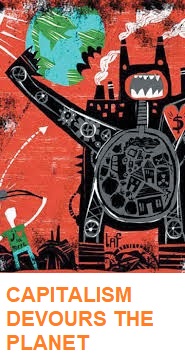
Capitalism - Humanity’s Enemy


 It is no longer possible to deny the urgency with which humanity must act to change if civilisation is to survive.  Humanity is at a turning point in history. We face multiple and massive environmental problems which will become irreversible so that the planet will not support the existing global civilisation. The destruction of the environment has reached calamitous proportions. It is a searing indictment of the short-sighted and disastrous policies of the capitalist system. The ‘Greenhouse Effect’ and wanton destruction of the environment is inevitable in a society dominated by blind market forces. The competition of interests makes capitalism absolutely incapable of developing adequate answers or even safeguards.


Our previous harmonious relationship with nature is broken; the cause is capitalism. The crisis arises because production is not geared to satisfy needs, but instead to produce profit.


Capitalists produce with the hope of gaining as large a share of the market as possible, and in the process, they collectively produce too much. The wastefulness of capitalist production is as much a strain on nature as it is on the fabric of society. Practically everything in this world is determined by profit and the capitalists concern themselves with the ecological problem only insofar as it affects their returns.


Capitalism is based on the principle of private property of where a small group of people "own" the Earth for the purpose of exploiting it for profit for their benefit. It is vital to appreciate that the widespread damage to the environment originates from the normal functioning of the system and not from its malfunction. It is not an aberration that can be cured. The ruling class has no good ideas about how to address the climate crises other than through the prism of the market and the stock exchange.


The World Socialist Movement says capitalism cannot save the planet from ecological disasters. It questions the ability of capitalism to foster a low carbon-emitting economy. The capitalist system is in direct conflict with nature. Profit consists of taking out more than you put in. This is certainly contrary to the socialist principle of a sustainable steady-state economy, “simple reproduction” as Marx called it, a balance of give and take. 


 Left-wing greens’ certainly talk the talk with proposed alternative solutions to environmental crisis which involves social reconstruction including direct grassroots democracy, decentralisation, cooperative enterprises, community ownership of productive resources, and workers control. They call for independent political action, outside the establishment political parties, based on local-rooted activist groups such as Extinction Rebellion and Sunrise, as well as the older more established lobbyist groups, Friends of the Earth and Greenpeace.


Those who try to regulate the system, in the end, merely make the road smoother for the corporations, once the vested interests in control of the state, modify, amend and water down their demands to make them more palatable for the capitalists. The market does not operate in abstraction. The political power wielded by corporations will prevent the rationality of human survival from triumphing over the irrationality of capital accumulation.


We cannot any longer ignore the accumulating and accelerating number of reports, and studies that have appeared which raise the prospect of serious harm to humanity and the scenario of our planet no longer being capable of supporting a modern civilisation and becoming effectively an unliveable world.


The Socialist Party has reached the conclusion that this system cannot be reformed. It is based on the destruction of the earth and the exploitation of the people. There is no such thing as green capitalism, no matter how radical capitalism is framed. Socialism would mean organising human communities in a manner that is compatible with the way that nature thrives. Capitalist society robs us of a healthy relationship with each other, creating rivalry, competition and hatred. If this type of society de-humanises us, we can fully expect to be alienated and estranged from our natural surroundings. Socialists strive towards a survivable society. To accept that many cultures must perish or radically transform the way we relate to one another and to nature is the question humanity has to face.  Failure to address this problem and answer it with solutions will only guarantee immense suffering associated with a societal collapse as ecological ruination comes to pass. The struggle for world socialism remains a necessity. Even if the socialist revolution we will still be in a global environmental crisis. However, the crucial point is that a socialist, democratic  society would not face the corporate and government apparatus of political obstruction and commercial resistance with insistence upon  “business as usual.” Nevertheless, we should be well aware that the longer the procrastination and postponement of the cooperative commonwealth, the more severe will be the consequences and the greater may be the required policies for halting carbon emissions.

Preserve Capitalism or Conserve the Planet?


The Socialist Party is for general emancipation, i.e. for a class-free society. But such emancipation presupposes the abolition of private property, of commodity production and of the market economy, as well as of competition and the private enrichment


The realisation of these goals is only possible when the socialist struggle for them is merged with the real struggle of a class that is materially interested in it, intellectually prepared for it, and socially inclined to it. This means a class that is potentially capable of bringing all wheels to a standstill if it so wishes; a class that, organised into the associated producers, is capable of taking over the organisation of production. The overthrow of capitalism, the transition to a class-free society, the replacement of domination by a free association of producers can emerge from the self-organisation and inevitable, the elementary class struggle of working people.


The educational and organisational activity, the stimulating of class consciousness and class organisation shall be the task of the Socialist Party and companion parties within the World Socialist Movement to build a society without private property, production of goods, money, enrichment, competition and nation-state. The practical task of abolishing the bondage of humanity thus becomes the practical politics of our organisation. Our case is one of the total renunciations of compromises. Such methods are unrealistic and impossible in our view and even if it means facing our opponents with our hands tied we make a principled stand. Endless scheming, unlimited willingness to make concessions, dishonest manoeuvres and total exclusion of self-activity, initiative and action of one’s own class leads to nothing and brings us no closer to the goal. Realpolitik and Machiavellianism can never be the strategy of the socialists because the emancipatory goal is not small but huge: to overturn all conditions in which people are degraded and enslaved. The unique nature of the socialist revolution is that it can only be realised by a conscious majority. To this end, it must conquer political power. The goal can only be achieved through the self-organisation and self-activity of working people.


Capitalists cannot exist without workers, but workers can exist without capitalists. As it is workers who actually do the producing, they are quite capable of undertaking this activity in their own interests. This cannot be accomplished unless workers are aware of their objective interests and are organised to achieve this goal. The socialist movement without a working-class is impossible. But a working-class which does not have the necessary knowledge to effect its transformation will not spontaneously evolve into a revolutionary force. For this to occur, workers in large enough numbers must develop sufficient knowledge concerning the nature of capitalist society, the nature of the state and the necessity of revolution to “change the world”.


In a democratically planned and ecologically rational society, many of the lifestyle changes that individualist environmentalism points to as necessary would occur, but as part of a social process of liberation, not as a forced sacrifice or moralistic principle. Work would be structured in ways that allow people to feel a closer connection with the production of food and resources. Overall, a socialist society would give us the freedom to live fulfilling lives less centred around consumption. The level of individual consumption will naturally decrease, without anyone forcing workers to lower their standard of living. Certainly, there would be changes in what people consume in a sustainable society — an ecologically sound agricultural system would probably supply less meat and less out-of-season produce — but this would occur because of a change in production in the context of revolutionary liberation leading to a better life (overall, such an agricultural system would supply healthier, cheaper and better-tasting food), so it would not be experienced as a sacrifice. All this being said, environmentalists must face the reality that much of the world does need higher levels of consumption — more stuff.


Billions of people in the world need, in order to live fulfilling lives, secure food and water, better transportation and communications infrastructure, and medical services. Under a democratic, planned programme of development, these resources could be produced in different, more efficient and ecologically sound ways, paid for by reparations from imperialist capital for its centuries of exploitation, and in concert with reducing the ecological footprint of the developed countries. If people have no secure means of subsistence to live, they will survive as best they can use what means are available to them, which tend to be highly ecologically destructive. Poverty is a major part of the reason there is so much deforestation. Renewable energy provision for the entire planet — and the eradication of poverty — would have to be part of any move to living sustainably with the Earth. The only way to both develop human potential around the world and regenerate a healthy biosphere is through the development of the productive forces of society.


 A democratically planned and ecologically rational society will be able to overcome the ways in which capitalism is holding us back from producing more efficiently and sustainably. In an economy designed to meet human needs, there would be many opportunities to eliminate waste: for example, by eliminating product packaging, by eliminating planned obsolescence so that electronic equipment and machines (e.g. laptops and mobile phones) will last longer, by reducing transportation through producing locally when most efficient, and by eliminating many industries — the financial services, and the military — that will be largely useless in a socialist society.


Further, the technological basis of society could be transformed. We could adopt a power system based around solar, wind, geothermal and tidal energy. We could redesign urban areas based on walking, bicycling and public transit. And we could transform our agricultural methods, drawing from organic agriculture and permaculture techniques.


All these transformations in production and social allocation of resources are possible with technologies that exist now, but capitalism’s drive for private profit holds us back from implementing them. An ecologically rational society is incompatible with capitalism. Ecology need not be treated as a separate concern that must be brought into other movements. Because all aspects of society are involved in the relation to nature, all struggles have an ecological dimension; and because a sustainable society and a socialist society are inseparable as the aspiration ecological demands belong in all struggles.


Our choice is to preserve capitalism or to conserve our planet.


Saturday, November 06, 2021

Denial and delusion


On Saturday the streets of Glasgow were filled by 100,000 people wishing to protect the planet from the ravages of the climate crisis. Similar marches seeking to defend the environment took place across the globe.


 COP 26 is said to be a pivotal world-changing moment in history because we may be approaching an ecological catastrophe and the COP26 attendees claim they will be able to provide remedies to the climate crises with agreed cures. Many at COP26 believe they are humanity’s last best hope. Yet if truth be told, they are found wanting for solutions. We will concede that climate change indeed presents a potentially revolutionary moment if we dare to take action.


There’s no techno-fixes and no stock market answers to global-warming. A shift to clean, green renewable energy sources could reduce fossil fuel emissions but more growth, more production, more consumption of resources, will still mean we are headed deeper into the climate crisis to be confronted by a possible civilisation collapse. Since cutting economic growth is unacceptable to businesses and governments, any such suggested approach is quickly abandoned. If there’s no capitalist solution to ending the plunder of the planet then the only other alternative is to replace capitalism.


This doesn’t mean we go back to pre-industrial times, that we discard all the material progress made over the last few centuries. But it does mean closing down wasteful and polluting industries. Much of the commercial world is socially unnecessary, the military and the armament manufacturers, the banking and financial sectors. We have fast junk-food instead of healthy, nutritious, fresh “slow food. We wear “fast fashion” clothes destined to landfill after a few outings. We have shelves upon shelves of disposable products with built-in obsolescence with superfluous packaging just to hook us into a purchase. We can completely redesign the production of appliances, electronics,  furniture and so on to be as durable and repairable. Homes can be constructed to last for centuries, to be energy efficient, to be shared by generations by being family-friendly. All these changes are simple, self-evident, no great technical challenge. They just require a completely different kind of economy, an economy geared to producing what we need while conserving resources. 


The question is this: will you stand by and protect the profit system rather than protect the planet? Our alternative is a pragmatic and practical vision of world socialism because its the only answer.


Business-as-usual with its various attempts to make climate action as compatible with the market (carbon trading, carbon offsets, monetising/commodifying nature) is driving us straight toward civilisation-threatening tipping points. Capitalism is all about ideology, it’s about class and class power which we need to abolish in order to get rid of capitalism. Common ownership and the cooperative commonwealth is what we have to build.


 It’s not magical thinking. Mitigation strategies such as consumerist lifestyle changes are half-measures, in themselves worthy aspirations but insufficient and ineffective to fully resolve our environment crisis.


Procrastinating over market-based policies or speculative geo-engineering schemes merely postpone the inevitable onset of extreme weather events. The system of capitalist production and the necessity of accumulation is fundamentally incompatible with any sustainable relationship between humanity and the environment. A supposedly tamed capitalism cannot salvage the planet from the savage ravages of the profit system.


Corporations cannot be co-opted to act as the green saviours of the Earth in the never-never land of “benevolent” capitalism. There are no “good” capitalists even if Bill Gates tries to canonise himself as a saint. None of the philanthropists fundamentally alter the economic system that is the problem and that is the problem.